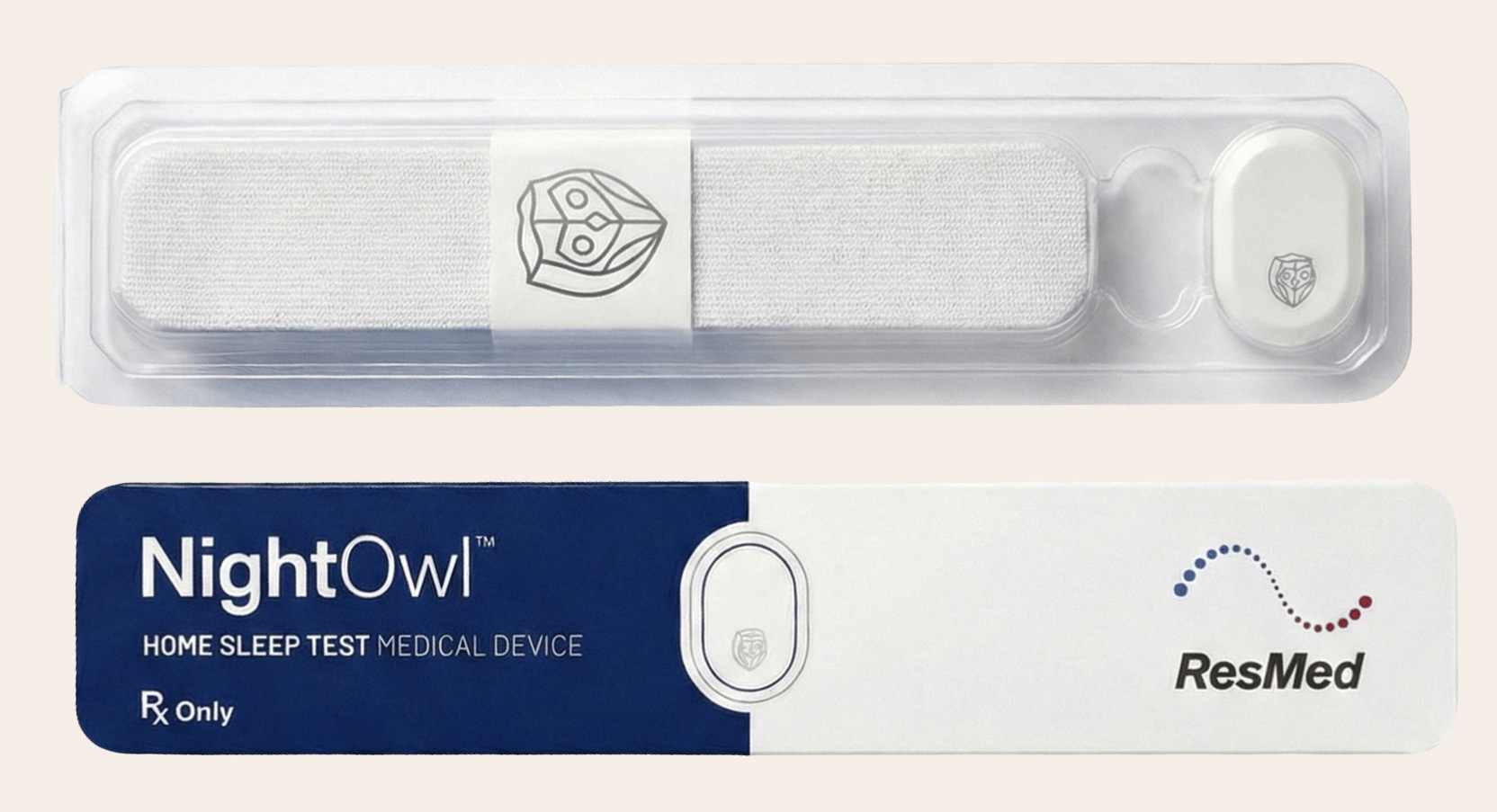
When ResMed acquired NightOwl, a disposable at-home sleep apnea diagnostic, the mandate was immediate: get to market fast, starting with a high-visibility trade show debut. The problem? No finalized brand direction. No product clarity. No visual assets to speak of.
With leadership still shaping long-term strategy and timelines already compressed, I stepped in to architect a provisional visual system, one designed to project credibility and polish at launch without prematurely committing to a brand identity still in formation. The work wasn't just execution under pressure; it was strategic design thinking that held space for what the brand could become.
>> Scroll to the end to view the full case study.
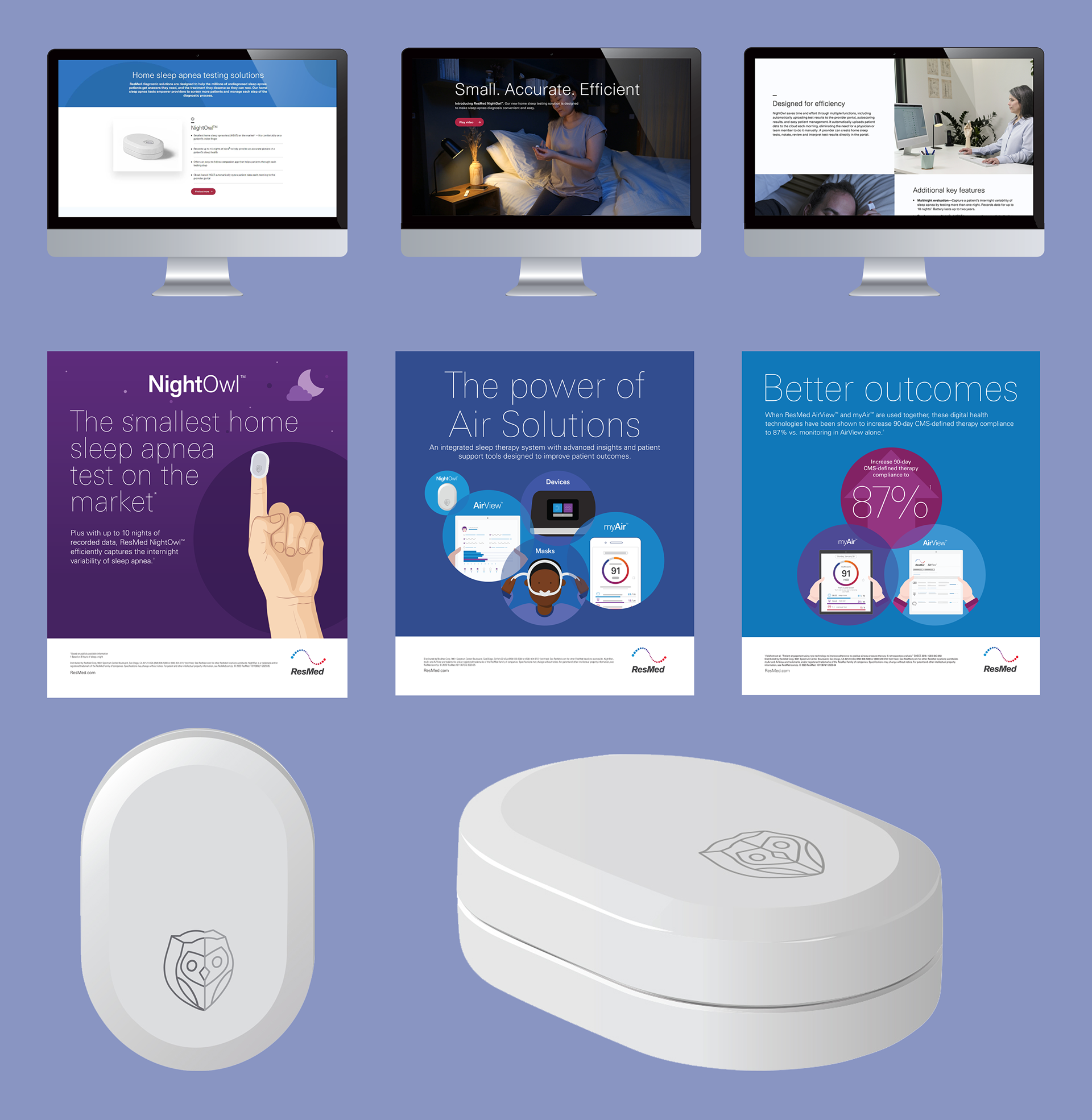
Printed Event Signage / Physician and HCP Audience

Launch Landing Page / Patient Audience
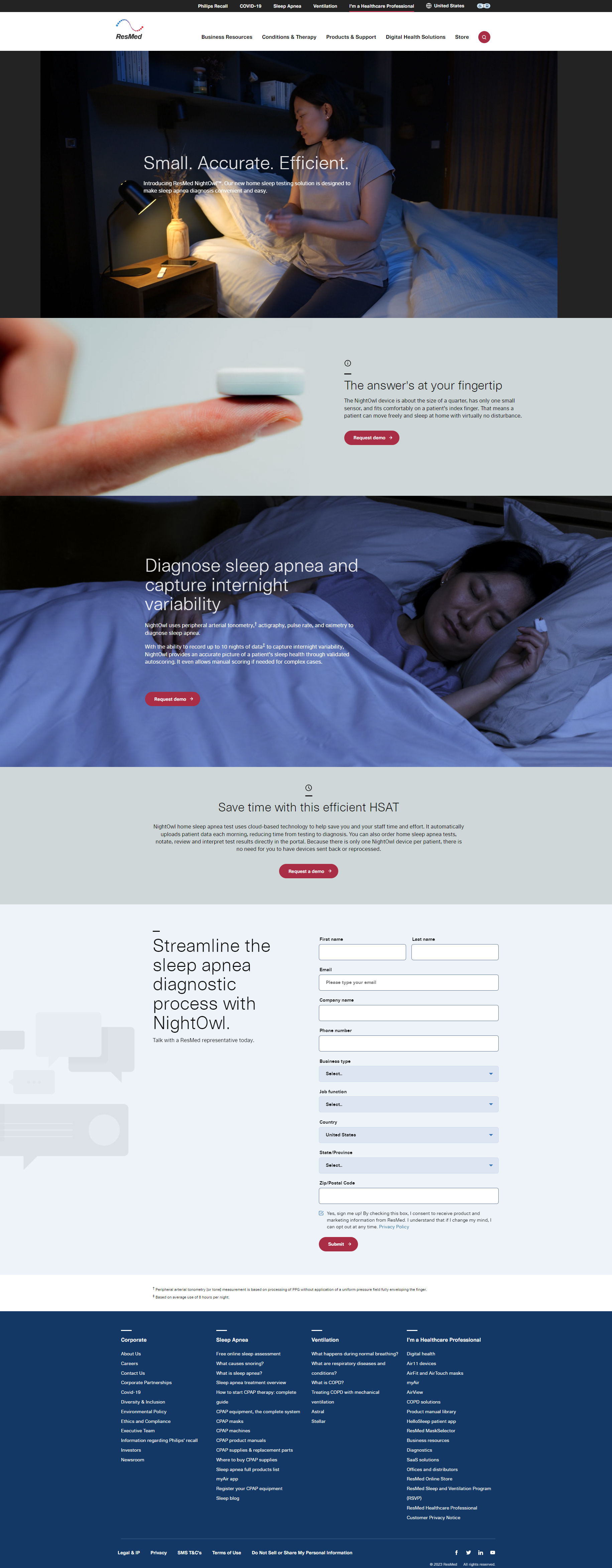
Client: ResMed
Role: Lead Graphic Designer + Illustrator
Team: Project Manager, Product Marketing Manager, Compliance, Legal, CopyWriter, Web Developer, Events Marketing Manager, Print Vendor
Tools: Adobe Illustrator, Adobe Photoshop, Adobe XD, Adobe WorkFront, Adobe Acrobat
Audience: Healthcare Practitioners
Role: Lead Graphic Designer + Illustrator
Team: Project Manager, Product Marketing Manager, Compliance, Legal, CopyWriter, Web Developer, Events Marketing Manager, Print Vendor
Tools: Adobe Illustrator, Adobe Photoshop, Adobe XD, Adobe WorkFront, Adobe Acrobat
Audience: Healthcare Practitioners
CASE STUDY: Rapid Trade Show Launch — ResMed Acquisition of NightOwl
The Challenge
• Launch an acquired product under the ResMed portfolio without a defined brand strategy
• Prepare trade show ready materials on an accelerated timeline
• Work with low-quality or unusable existing assets
• Operate with a small team and limited cross-functional bandwidth
• Navigate uncertainty around product positioning, naming, and future branding direction
• Ensure all materials still met clinical and regulatory expectations
• Launch an acquired product under the ResMed portfolio without a defined brand strategy
• Prepare trade show ready materials on an accelerated timeline
• Work with low-quality or unusable existing assets
• Operate with a small team and limited cross-functional bandwidth
• Navigate uncertainty around product positioning, naming, and future branding direction
• Ensure all materials still met clinical and regulatory expectations
This created a tension between speed and quality with high visibility and little room for error.
Strategic Approach: Designing for the “In-Between”
Rather than forcing a premature brand identity, I positioned the work as a transitional visual system, intentionally flexible, elevated, and distinct enough to stand on its own, but neutral enough to evolve once long-term branding decisions were finalized.
Rather than forcing a premature brand identity, I positioned the work as a transitional visual system, intentionally flexible, elevated, and distinct enough to stand on its own, but neutral enough to evolve once long-term branding decisions were finalized.
The key was to create something that felt:
• Intentional, not temporary
• Clinically credible, yet visually differentiated
• Scalable across trade show and print applications
• Intentional, not temporary
• Clinically credible, yet visually differentiated
• Scalable across trade show and print applications
Creative Solution: Illustration-Led Visual System
With photography off the table, I made the decision to pivot To illustration as the primary visual language.
This approach solved multiple challenges at once:
• Eliminated reliance on poor-quality product imagery
• Created a cohesive and controlled aesthetic
• Allowed us to highlight the device’s form and functionality with clarity
With photography off the table, I made the decision to pivot To illustration as the primary visual language.
This approach solved multiple challenges at once:
• Eliminated reliance on poor-quality product imagery
• Created a cohesive and controlled aesthetic
• Allowed us to highlight the device’s form and functionality with clarity
Key elements included:
• Custom device illustrations: Clean, simplified renderings that emphasized form, usability, and wearability
• Illustrative poster series: Designed for large-format trade show environments, focusing on clarity at distance and visual impact
• Minimalist brand colors and layout system: Ensured readability and alignment with healthcare expectations
• Feature callouts and diagrams: Used illustration to communicate product benefits more effectively than photography could at that stage
• Custom device illustrations: Clean, simplified renderings that emphasized form, usability, and wearability
• Illustrative poster series: Designed for large-format trade show environments, focusing on clarity at distance and visual impact
• Minimalist brand colors and layout system: Ensured readability and alignment with healthcare expectations
• Feature callouts and diagrams: Used illustration to communicate product benefits more effectively than photography could at that stage
This direction transformed a limitation into a distinctive visual advantage, helping the product stand out on the trade show floor.
Print Design Execution
The primary deliverables centered on high-impact print materials for trade show deployment:
• Large-format posters and booth graphics
• Informational panels and product highlight boards
• Quick-reference handouts and supporting collateral
The primary deliverables centered on high-impact print materials for trade show deployment:
• Large-format posters and booth graphics
• Informational panels and product highlight boards
• Quick-reference handouts and supporting collateral
My contributions included:
• Designing for environment: Created layouts optimized for trade show visibility clear hierarchy, bold focal points, and legibility from a distance
• Systematizing content: Built a repeatable structure for messaging and visuals, enabling fast production despite evolving inputs
• Production readiness: Prepared print files with consideration for scale, materials, and installation constraints
• Rapid iteration: Worked in tight feedback loops with stakeholders to refine messaging as new information became available
• Designing for environment: Created layouts optimized for trade show visibility clear hierarchy, bold focal points, and legibility from a distance
• Systematizing content: Built a repeatable structure for messaging and visuals, enabling fast production despite evolving inputs
• Production readiness: Prepared print files with consideration for scale, materials, and installation constraints
• Rapid iteration: Worked in tight feedback loops with stakeholders to refine messaging as new information became available
Operational Complexity
This project required navigating a high degree of ambiguity:
• Incomplete information: Product details and positioning evolved in real time
• Unclear future state: Designs needed to avoid conflicting with potential future branding
• Tight turnaround: Minimal time for exploration or multiple concept rounds
• Small team dynamics: Required stepping beyond traditional role boundaries to keep momentum
This project required navigating a high degree of ambiguity:
• Incomplete information: Product details and positioning evolved in real time
• Unclear future state: Designs needed to avoid conflicting with potential future branding
• Tight turnaround: Minimal time for exploration or multiple concept rounds
• Small team dynamics: Required stepping beyond traditional role boundaries to keep momentum
To manage this, I:
• Established clear design principles early to guide fast decision-making
• Focused on scalable solutions rather than one-off executions
• Prioritized clarity and usability over unnecessary complexity
• Established clear design principles early to guide fast decision-making
• Focused on scalable solutions rather than one-off executions
• Prioritized clarity and usability over unnecessary complexity
Impact
• Delivered a fully realized trade show presence on time, despite significant constraints
• Elevated perception of the newly acquired product through a cohesive, high-quality visual system
• Enabled stakeholders to confidently showcase the product before final brand decisions were made
• Created a flexible foundation that could later evolve into a permanent brand direction
• Demonstrated the effectiveness of illustration as a strategic tool in healthcare marketing
• Delivered a fully realized trade show presence on time, despite significant constraints
• Elevated perception of the newly acquired product through a cohesive, high-quality visual system
• Enabled stakeholders to confidently showcase the product before final brand decisions were made
• Created a flexible foundation that could later evolve into a permanent brand direction
• Demonstrated the effectiveness of illustration as a strategic tool in healthcare marketing
Key Takeaway
This project highlights my ability to lead design in ambiguous, fast-moving environments, especially within healthcare and medtech contexts where clarity and credibility are critical.
This project highlights my ability to lead design in ambiguous, fast-moving environments, especially within healthcare and medtech contexts where clarity and credibility are critical.
By recognizing when traditional approaches wouldn’t work and pivoting to a more controlled, illustration-driven system, I was able to deliver a solution that was not only practical, but strategically differentiated and visually impactful.